
You have recently joined the pharmaceutical industry as a fresher, and by now, you already know that being a Medical Representative is a highly target-based job. But a very common question arises in the mind of every newcomer: how exactly will you fulfill your monthly target?
Is your target officially achieved when a retail pharmacy places an order for your products? Or does it happen at the exact moment when a doctor prescribes your brand to a patient?
For freshers, there are so many confusions surrounding these basic terms in the beginning. Isn’t it? But don’t worry at all. I will help you to understand this simply, without using any complicated corporate jargon.
One fundamental thing you must know is that you can only achieve your long-term target if your core customers—the doctors—write your brand on their prescription pads. Still, to master your territory’s business, you must clearly know about the different types of sales.
Basically, in the pharmaceutical industry, there are two main types of sales: Primary Sales and Secondary Sales. However, before going deep into these two specific terms, you must understand the basic distribution chain first.
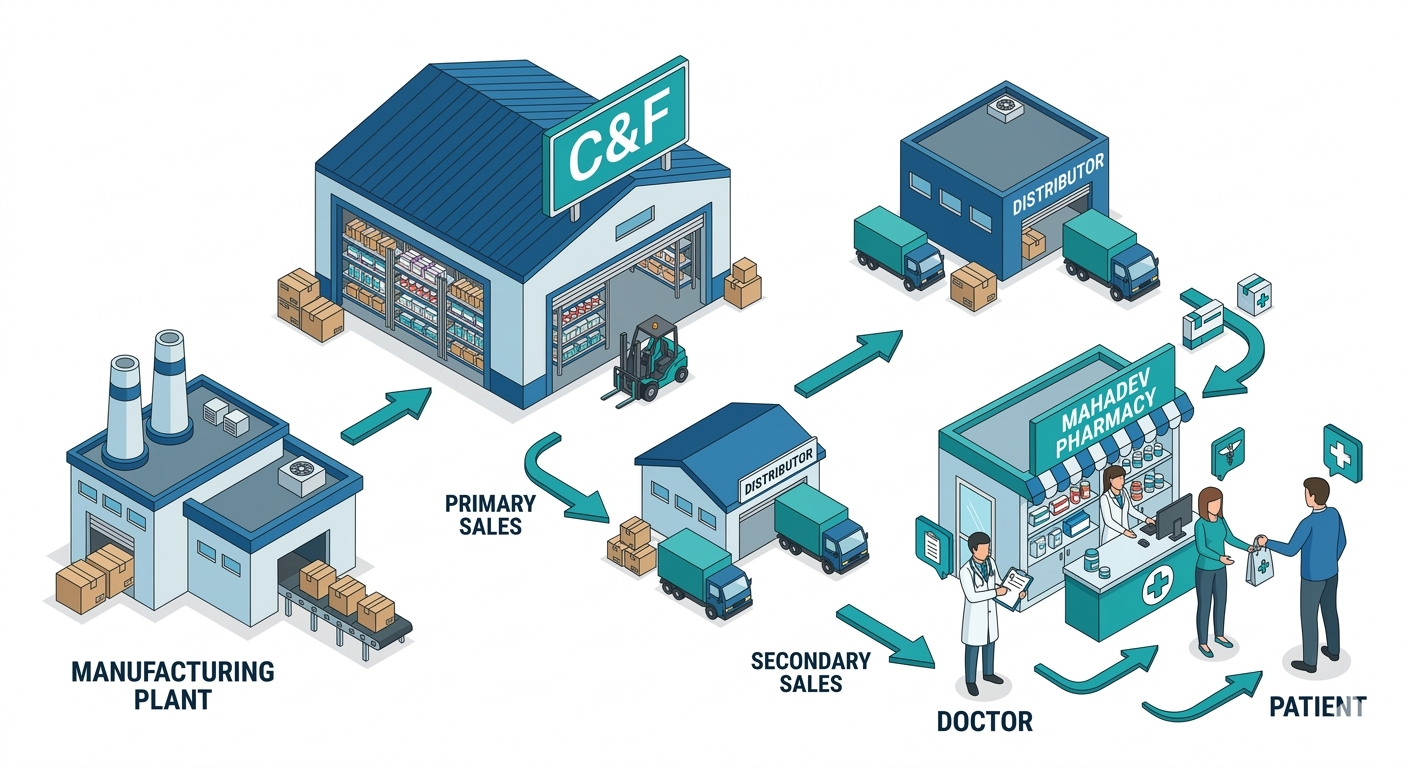
Let’s start from the very beginning. The place where your company’s brands are getting manufactured is called the plant. From that manufacturing plant, a brand is transported and reaches the C&F, which stands for Carrying and Forwarding agent. This C&F is the central hub or the place where all the pharmaceutical products for a specific state or region are getting stored safely.
From this C&F, a brand is then dispatched and reaches a Distributor located in your specific Headquarter (HQ). Suppose in your assigned HQ, there are a total of 4 authorized Distributors: let’s call them Distributor A, B, C, and D. It means that within your Headquarter, all of your company’s products are officially available at the shops of these four specific Distributors. I hope till now, the flow of the product is absolutely clear to you.
Now, let’s take a practical example from your daily fieldwork. Suppose a doctor named Dr. Z is practicing his profession at a clinic attached to Mahadev Pharmacy. Through your regular visits, you have convinced him, and Dr. Z has prescribed your brand for a patient who goes to buy it from Mahadev Pharmacy.
Now, what will the pharmacy do? Suppose your brand is not currently available there. In this scenario, Mahadev Pharmacy will visit or contact any of the authorized distributors from your HQ—either A, B, C, or D—and purchase your brand from them to supply it to the patient.
This entire cycle is the simple distribution channel of pharmaceutical sales. Now that you understand the journey of the product, let’s look at the exact definitions.
Primary Sales:
When your brand is not available or goes out of stock at the distributor’s end, your Distributor will place a fresh order directly to the C&F as per his market requirements. The billing transaction that happens between the company’s C&F and the Distributor is called Primary Sales.
Secondary Sales:
When your brand is not available at the retail chemist counter or goes out of stock due to regular doctor prescriptions, that retail pharmacy will place an order to your local Distributor. The transaction that happens between the Distributor and the retail pharmacy is called Secondary Sales.
So overall, looking at this entire chain, we can clearly say that Primary Sales is heavily dependent on Secondary Sales. If the pharmacy doesn’t sell the medicine to patients, the distributor won’t buy more stock from the company. However, as a Medical Representative, your official monthly target always gets calculated based on your Primary Sales.
To sum it up, as a fresher, you should not get confused or overwhelmed by these corporate terms. Always remember the golden rule of pharmaceutical sales: Your ultimate focus should always be on generating prescriptions from your doctors.
When your doctors prescribe your brand, secondary sales will happen automatically at the retail counters. And when secondary sales increase, your distributor’s stock will empty fast, and he will automatically place bigger orders to the C&F, fulfilling your primary sales target! Focus on your in-clinic effectiveness and relationship building; the sales numbers will follow.